Back to Main Site Download Full Report

State of Nonprofits 2026

What Funders Need To Know

Download Full Report

Overview

Nonprofit organizations across the country are navigating an extraordinarily difficult context. As we reported in January 2026, many are contending with simultaneous and compounding pressures, including greater demand for their services and an increasingly challenging funding landscape. These pressures land on nonprofits that were already stressed by the pandemic and by widespread feelings of burnout. In response, many nonprofit organizations have had to adapt to make it through this time and continue to provide programs and services.

In our "State of Nonprofits 2026" report, the fourth in CEP’s annual series, we continue to elevate the perspectives of nonprofit leaders and aim to provide a clearer understanding of the pressures they are facing and the steadfast ways they’re responding to mounting challenges.


Foundation leaders, if you're interested in sharing a brief summary of this research with your board, please see the accompanying Board Book Insert.

Our research aims to:

Take the pulse of nonprofit leaders via CEP’s Nonprofit Voice Project, a nationally representative panel of U.S. nonprofits that receive foundation funding.

Examine change over time in nonprofit leaders’ perspectives and experiences.

Help funders, both individual and institutional, better understand the nonprofit experience so they can more effectively support the organizations they fund.

We surveyed:

0

nonprofit leaders

0

responded

representing a 43% response rate

1 / 10
1

Finding 1

Worsening CEO Burnout

Burnout has increased dramatically among nonprofit CEOs, who say the current context has contributed to lower staff morale and heightened levels of stress and fear.


The proportion of nonprofit CEOs who report that their own burnout is very much a concern jumped to 46% in 2026, up from just under 30% in 2025.

Nonprofit CEOs' Levels of Concern About Their Own Burnout, 2024-2026 (Ns=239-584)

"As the executive director, I have been going through my first-ever, incredibly intense burnout. My entire holiday vacation, I could barely leave the couch or the bed. I looked into sabbatical options, but there are none available for my industry, location, or size of staff."

– Nonprofit Leader

Many factors are contributing to this more challenging environment for nonprofit staff and leaders.

Nonprofit Experiences Since January 2025 (N=368-372)

Nonprofit CEOs report different experiences within the current context. Our analyses suggest that nonprofits with LGBTQ+ CEOs and CEOs of color, as well as nonprofits focused on social justice, experienced more pronounced threats than their peers.

25%

of nonprofit CEOs now believe burnout is significantly impacting their staff.

Extent to Which Burnout Is Currently Impacting Nonprofit Staff (N=370-584)

"Our amazing team is overworked and overloaded from demand for services, but we are unable to expand staffing given the current financial environment. Losing a single employee would be devastating."

– Nonprofit Leader

1 / 7
2

Finding 2

Unpredictable Funding Environment

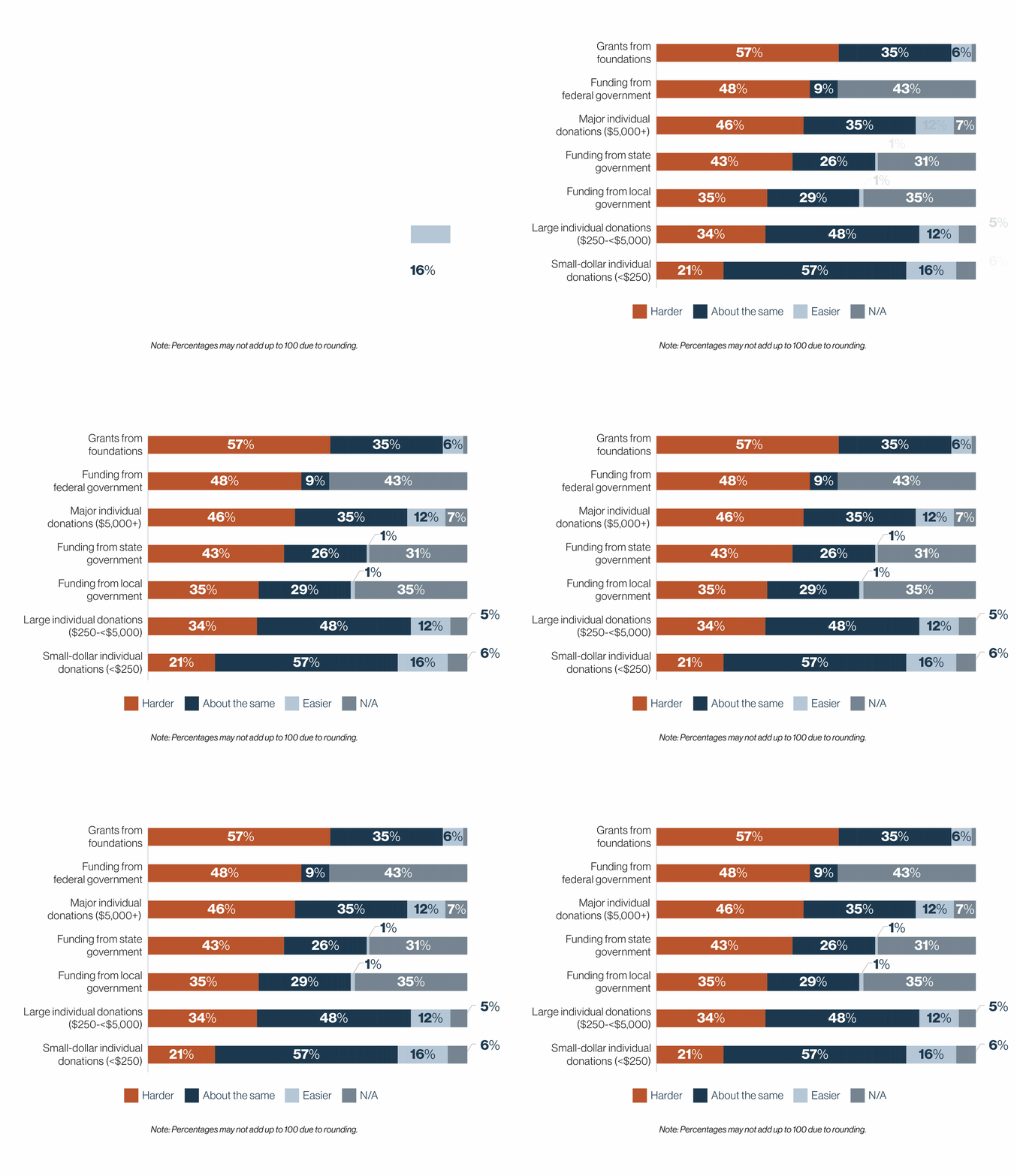
Nonprofit CEOs report more difficulty obtaining foundation funding than in previous years.

57%

of nonprofit CEOs say it's been harder to secure foundation grants since January 2025.

Change in Level of Difficulty Nonprofits Report in Getting Funding Since January 2025 (N=377-378)​

"Our biggest challenge is higher volatility in giving. More foundations than we would expect in a typical year have reduced or dropped their support."

– Nonprofit Leader

44%

of nonprofit CEOs report reduced funding from foundation funders since January 2025.

Percentage of Nonprofits Experiencing Funding Losses by Funding Source (N=374-378)

"Although we are not directly impacted by loss of federal funding—because we do not and have not gotten federal funding—we feel the downstream effects acutely. Those who previously relied on federal funding are now turning to our existing donor base, resulting in overload for donors and less money to be distributed to individual organizations such as ours."

– Nonprofit Leader

1 / 11
3

Finding 3

Responding to Financial Challenges

Despite ongoing financial challenges, many nonprofits are making strategic adaptations to their work in order to survive.
66%

of nonprofit CEOs say they have concerns about their organization’s financial stability.

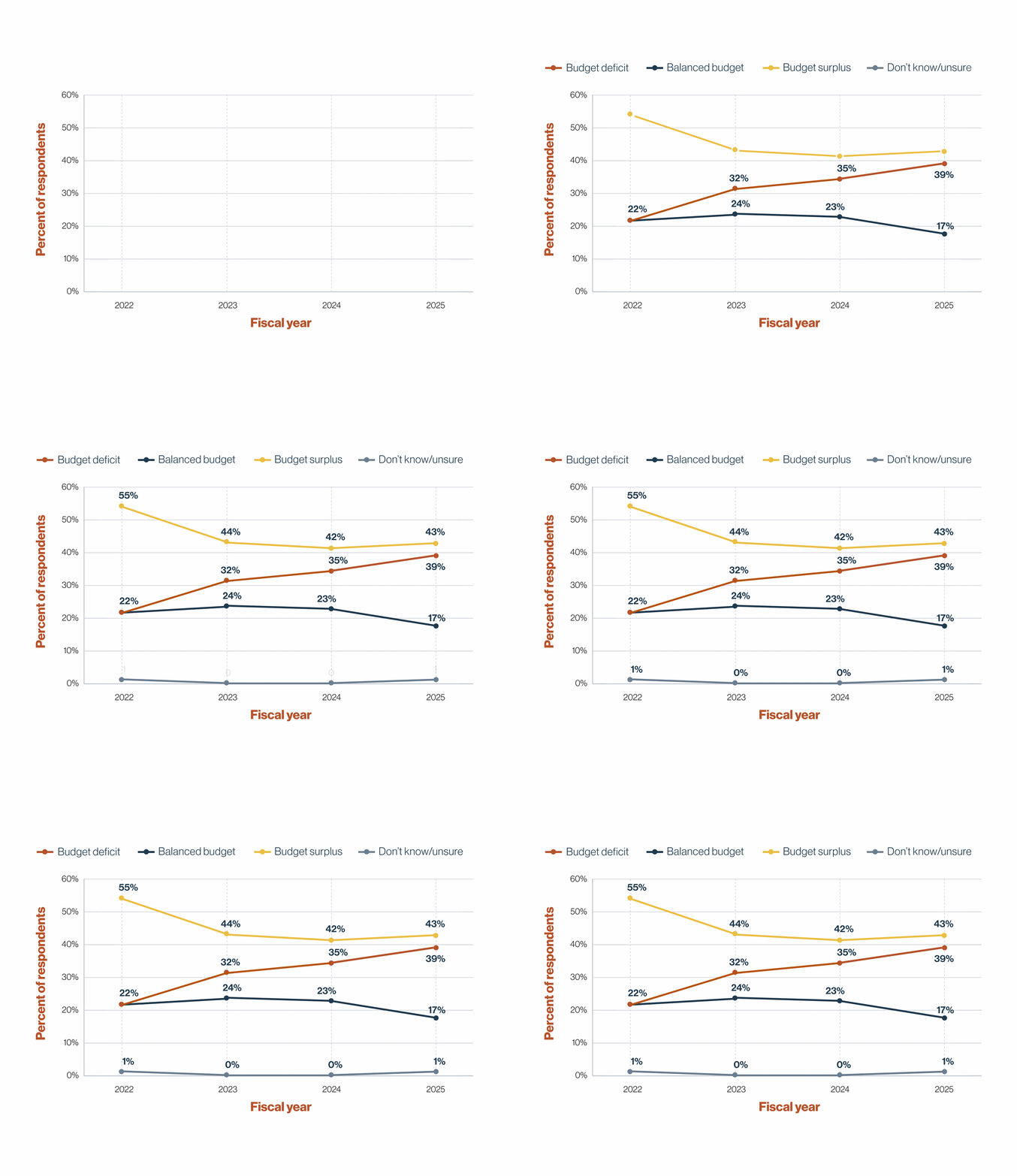
The proportion of nonprofits reporting a deficit rose to 39% in 2025, up from 22% in 2022.

Trends in Fiscal Year Budget Status, 2022-2025 (Ns=239-583)
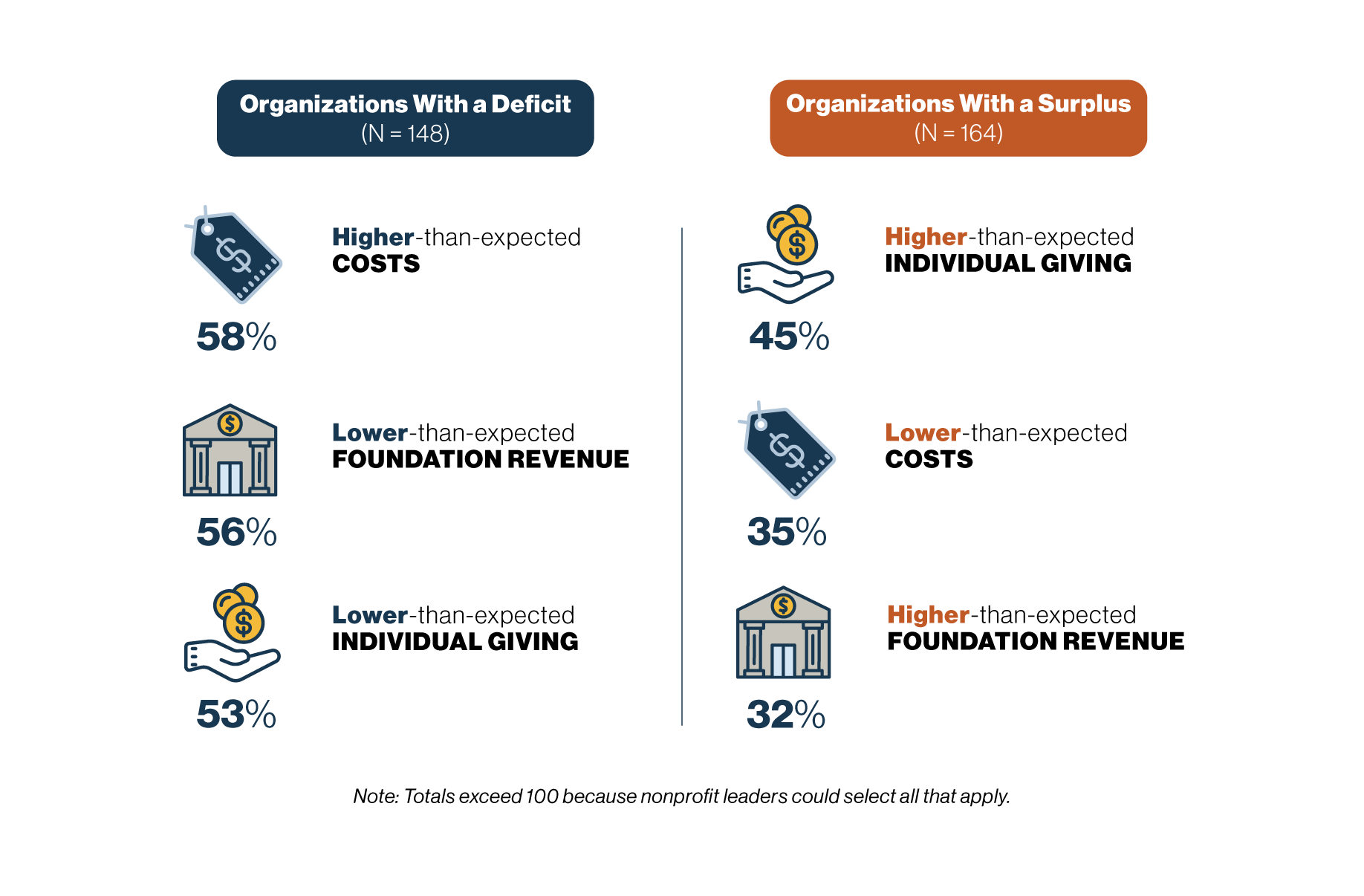
Top Contributors to Last Year’s Financial Situation for Nonprofits
"We are working to break even and survive rather than thrive and expand."

– Nonprofit Leader

Since January 2025, some nonprofits have implemented significant changes to maintain or improve their financial sustainability.

"We have started to prioritize diversifying our funding streams as much as possible. This includes identifying and applying for novel grants, working to expand our individual donor base, and pursuing opportunities through funding co-ops."

– Nonprofit Leader

Financial Actions Nonprofits Are Considering Taking (N=380)

Percentage of Nonprofits Considering or Making Larger Operational or Organizational Changes (N=370-376)

"[We are] cutting fat and tightening up operations. But that also means we’re all working at 175%, and it is not sustainable."

– Nonprofit Leader

Conclusion

The pressures facing nonprofit organizations are enormous. Burnout, for both nonprofit staff and leadership, has intensified in the last year, as many organizations confront a combination of increased demand for their services and a tougher funding environment. Nonprofit CEOs report foundation funding has become increasingly difficult to secure relative to previous years. As a result of these challenges, nonprofit leaders have had to make difficult and sometimes dramatic changes to their work to see their staff, organizations, and communities through the current context.

If this report has been helpful to you, please consider supporting CEP’s research. Reach out to us for more information. Thank you.

Download Full Report