

“Our biggest challenge is higher volatility in giving. More foundations than we would expect in a typical year have reduced or dropped their support.” – A nonprofit leader
This statement, included in CEP’s unflinching report on the state of the nonprofit sector, isn’t just about too little money; it’s about too much uncertainty. The importance of foundations not hoarding financial capital is well covered by others. The importance of funders hoarding uncertainty, however, needs an advocate. So here I am.
Some uncertainty is normal – even helpful. It’s fuel for creativity and innovation; it pries open windows of opportunity. But too much uncertainty can have the opposite effect. And right now, nonprofits are awash in uncertainty. There’s uncertainty created simply because a sector fraying from strain and swelling demand cannot hold forever, yet we don’t know if or when it will break. There’s uncertainty created by a volatile context that is grinding down staff and constituents’ wellbeing. And there’s a larger uncertainty about the viability of so much that seemed at least somewhat solid a few years ago: that a federal grant once awarded will be honored, that staff with temporary protected status will continue to have that status unless given a long lead time of notice — those were a few of the many background certainties that seemed so obvious we didn’t state them as assumptions when constructing our theories of change, when tweaking our strategic plans.
But volatility in foundation funding isn’t an inevitable by-product of all this external chaos; it’s manufactured within our sector. It can be true both that much of the uncertainty crushing nonprofits is not directly caused by philanthropy, and also that philanthropic behavior is stoking highly consequential uncertainty and hobbling the sector at the very moment we need it to be dancing.
Unbridled Uncertainty Is Costly
As nonprofits’ uncertainty goes up, so too do costs, measured in dollars, trust, impact, and productivity. Scenario planning, making and then reversing decisions, pivoting, insulating staff and communities from anxiety — these take energy and time, focus and money. Every leadership team meeting, board meeting, weekend, and late night spent generating, analyzing, tweaking yet another spreadsheet is a leadership team meeting, board meeting, weekend, and late night not spent on actual leadership toward that organization’s mission.
Yes, this is all part of the job. Except, for too many nonprofit leaders right now, this is the near-totality of the job. It’s costing us all — in great people burning out, communities not getting what they deserve and need, and organizations moving from periodic strategic pivoting to frenetic swirling.
Funders Create Uncertainty
Funders’ quest to increase their own certainty that they are making a “good” grant can increase uncertainty for nonprofits. For example, to consider as much impact data as possible from a project, renewal decisions can take many months and be announced only weeks before the close of the current grant.
This is not a new phenomenon, but in 2026, nonprofits cannot bridge and cover nearly as well as they could before, and so they have to pivot, suddenly. When operating reserves are thin, staff are stretched and stressed, and demand is up, nonprofit leadership has to decide: do we proceed as if we won’t get funded, even if that means carefully extracting ourselves from community, shrinking a program, or laying off staff that we might need two months from now if we were funded? Or do we proceed as if we will get funded, even if that means we’ll have to make some sudden changes if we’re wrong, and we know that because it will be abrupt, the trauma will be deeper and the injustices magnified? This is not Schrödinger’s Cat — a nonprofit cannot do both at the same time, and there are consequences to every decision.
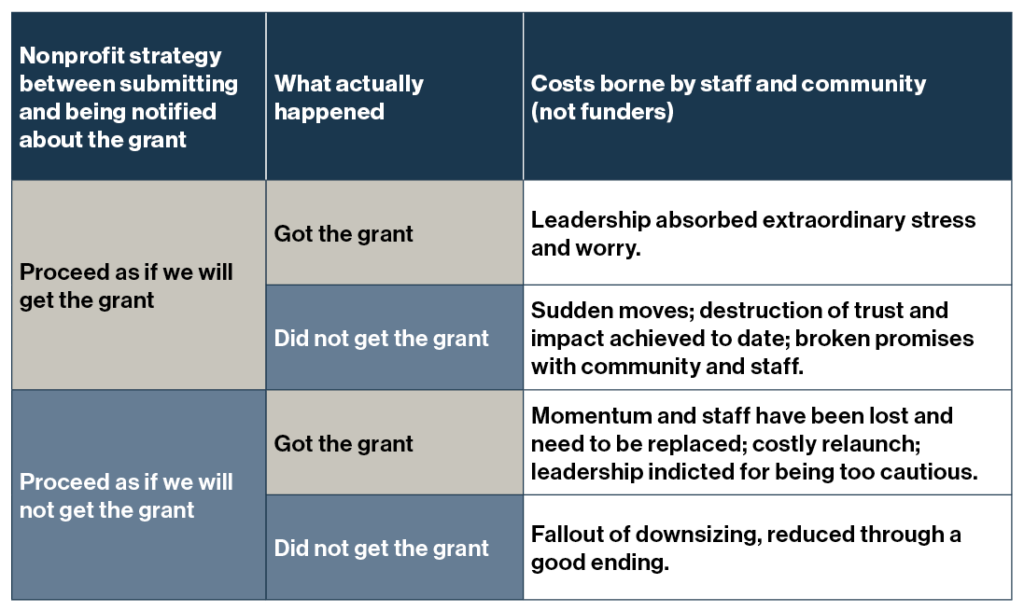
None of these is the “right” option, and a leader might proceed differently with different grants. But every path contributes to burnout — even the first, seemingly optimal one.
Nonprofit leaders’ extraordinary efforts to manage uncertainty created by philanthropic practices isn’t unique to funding renewals. A foundation can change focus areas or strategy with little notice to grantees who will no longer qualify for support, even if the philanthropy’s program officers feel like the planning process was interminable.
The solution isn’t for funders to never leave grantees or change strategies. The solution is to leave very differently. There are case examples and lessons learned, but they aren’t sinking in. So the defacto norm that nonprofits have to plan around is “at any time, with little notice.” It’s a great big pothole of uncertainty and responsibility that nonprofits are expected to patch, alone.
In The Calculus of Leaving, I show just how much impact, community trust, and ability to behave strategically is forfeited when funders announce renewal decisions at the last moment. I also show that by funders’ eliminating the need for grantees to scenario plan as in the above chart, the same dollars go farther and do more good.
There are multiple ways to do this. A funder could make a renewal decision a year before the end of the current grant, or commit at the beginning of the original grant to funding a “tail” if the grant were not renewed. There are other configurations, but whatever the approach uncertainty only decreases if the nonprofit knows the funder’s approach well in advance.
Three Principles for Hoarding Uncertainty
Funders need to hoard uncertainty so community and nonprofits can focus less on taking care of philanthropists, and more on taking care of relationships, mission, and impact. In the absence of an “uncertainty audit” tool, philanthropy can start with three principles. For those deeply engaged in trust-based philanthropy and resonant efforts, these will rhyme with your orientation; for others they may be more of a stretch. And the pain in that stretch? That’s you, loading up on uncertainty and protecting your grantees.
- Be steady: No sudden moves that decrease the amount, flow, or flexibility of capital (sudden increasing of these things is rarely cause for concern). Three ways to do this that aren’t mutually exclusive are to (i) commit explicitly to giving significant notice (try a year) before making major changes to how you fund a nonprofit, field, or geography; (ii) fund your exit from a field or from a relationship with a grantee or community; and (iii) reduce the time between application and award as much as you can. And then go back and reduce it even more, giving up some of your certainty advantage.
- Be realistic: Behave as if your support will not be replaced when you leave a grantee, a field, or a community. It’s not wrong for a funder to change strategy, or to stop funding an organization or a community. But it is wrong for a funder to feed uncertainty through sudden moves, and then blame the nonprofit for not being able to compensate. Behaving as if your support won’t be replaced might change whether or not you leave; it almost certainly will change how you leave. You’ll probably do it well, taking as much — maybe more — care in how you exit a relationship as how you entered it.
- Be clear: Name that endings happen, and how you deal with them. For example, in your grant award letter, include a statement about how much notification you give grantees about a significant reduction or elimination of funding or the end of the funding relationship. Whether your practice is one month or two year’s notice, your clarity helps nonprofits plan.
What if philanthropy took this stance? As part of a commitment to effectiveness, efficiency, equity, and decency, it is our role to (i) insulate our grantees and their communities from uncertainty whenever possible, and (ii) minimize uncertainty we create for grantees and the field. We recognize this means we need to tolerate less certainty and take bigger chances, but that’s been our job all along. We’re just growing into it.
Philanthropy can’t fix everything. But it can fix itself. Reducing the uncertainty foisted on nonprofits is an excellent place to start.
Katya Fels Smyth is a senior fellow at the Lilly Family School of Philanthropy, Indiana University, where she focuses on “WellLeaving”: increasing care and accountability for how funders exit relationships with nonprofits, and how nonprofits exit relationships with communities.