
Most funders agree on what nonprofits need to thrive: flexibility, trust, and sustained support. These principles are widely endorsed, reflected in conference panels and board conversations alike. Yet multiyear general operating support, one of the clearest ways to embody those values, remains less common than that consensus might suggest.
The gap between belief and practice is not about disagreement. It’s about follow-through. And that gap has real consequences for nonprofit stability, strategy, and impact.
What the Evidence Continues to Show
Nonprofit leaders have been remarkably consistent. Flexible funding allows organizations to direct resources where they are most needed: retaining staff, investing in infrastructure, strengthening technology, and responding to emerging community needs. Multiyear commitments add something equally important: predictability. When funding extends beyond a single year, leaders can plan, hire, and invest with greater confidence.
CEP’s report, “New Attitudes, Old Practices,” found that foundation leaders overwhelmingly supported multiyear general operating support in principle, yet these grants made up only a modest share of actual giving. The endorsement was clear; the implementation was limited. More recent data suggest that this dynamic persists.
Exponent Philanthropy’s 2026 Foundation Operations and Management Report found that while general operating support is widespread, it is most often awarded for a single year. Eighty percent of participating foundations reported making single-year general operating support grants, compared with just 32% that awarded general operating support over multiple years.
When funders do make multiyear commitments, those grants typically extend support over time rather than increase annual award size, averaging nearly $68,000 across three years compared with about $51,000 for single-year grants.
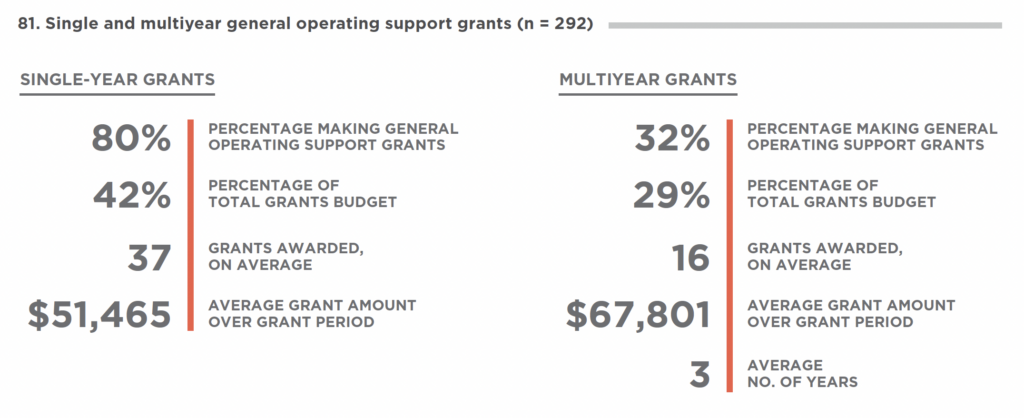
In other words, multiyear general operating support is more often used to keep funding steady than to deepen annual investment.
The data reinforce what CEP identified years ago: strong philosophical alignment has not yet translated into structural change.
Why Implementation Still Stalls
If most leaders agree in principle, why does practice lag?
For many funders, hesitation is not ideological; it is operational. Boards may worry about locking in commitments across uncertain economic cycles. Staff may feel constrained by payout requirements or annual budgeting norms. Systems built around project-specific outcomes and yearly grant dockets can make multiyear commitments feel administratively complex.
Accountability concerns also surface. Some leaders equate longer commitments with reduced oversight, even though multiyear general operating support can include clear expectations, annual updates, and opportunities to revisit assumptions if circumstances change.
In many cases, habits, not opposition, are the greatest barrier. Annual cycles are familiar. Project grants feel concrete. Multiyear general operating support requires a shift in mindset from controlling inputs to strengthening institutions.
What Moving Forward Often Looks Like
As detailed in Exponent Philanthropy’s “The Hows and Whys of Multiyear General Operating Support,” the Luther I. Replogle Foundation’s experience illustrates how that shift can unfold in practice.
After piloting multiyear grants in 2007, the foundation stepped back during the economic downturn, when long-term commitments felt riskier. Years later, leaders reintroduced multiyear general operating support with greater intentionality.
Rather than overhauling the entire portfolio, they began with three-year grants to a small group of long-standing, trusted partners. Payments were spread over time, reporting requirements remained the same as for one-year grants, and the framing shifted from managing “risk” to strengthening “stability.”
Board support followed — not because risk disappeared, but because the approach was structured and deliberate.
This incremental path reflects how many foundations move forward. They test multiyear grants within established relationships. They limit the number of grants at first. They structure disbursements over time and maintain simple reporting.
In practice, multiyear general operating support often fits within existing systems with minimal disruption. Over time, it can even reduce administrative burden by decreasing annual renewals and allowing conversations to focus less on compliance and more on long-term organizational health.
The shift does not require a dramatic redesign. It requires alignment between stated values and structural choices.
From Agreement to Alignment
Philanthropy has increasingly embraced the stated language of trust, partnership, and equity. Multiyear general operating support is one of the most direct ways to translate those commitments into funding practice.
When grants are short-term and restricted by default, nonprofits are left to manage the uncertainty — and in the last year, that uncertainty has only risen as the funding environment has become increasingly challenging, placing many nonprofits in dire straits, as CEP recently reported. That creates a gap between what funders say they value, stability and partnership, and how funding actually works.
Closing the gap does not require sweeping change overnight. For many foundations, it begins with a pilot, a reframing of accountability, or a board conversation grounded in data and experience. Incremental shifts can move multiyear general operating support from a rare exception to a reliable tool.
We know what nonprofits need. The question is whether we are willing to build funding practices that reflect that knowledge.
Hannah Smith is manager of editorial and publications at Exponent Philanthropy.