

This is the first in a series of occasional chats among some of CEP’s staff we’ll be posting on the blog, in which they discuss the current context for philanthropy and nonprofits. In this conversation, CEP’s Vice President of Assessment and Advisory Services Kevin Bolduc and CEP’s President Phil Buchanan reflect on the first 100 days of the Trump administration.
Kevin: Well, Phil, everyone has been trying to make sense of a very chaotic first 100 days of this presidential administration. Like so many people, I’m a combination of angered by the deportations (and disappearances) of people without any due process; incredibly sad about the lives already affected — and undoubtedly lost — as federal funding is dismantled; and disappointed about the way some powerful actors seem to have capitulated without much of a fight.
That’s why it has been encouraging to see some of the voices in our sector stand out. MacArthur Foundation’s president, John Palfrey, has been seemingly everywhere trying to inspire all of us to take action1. He’s right that “courage is contagious.” We’re going to need solidarity in the coming months. Maybe he can give one of those MacArthur genius grants to Diane Yentel at the National Council of Nonprofits (NCN). Her leadership for funders and nonprofits alike has been unparalleled. I think you called her your spirit animal a few weeks back.
Phil: “Spirit animal” are words I have literally never spoken. But Diane is an inspiring leader and seems to be exactly the right person for this moment. She should get every prize. I did send her an email saying so out of the blue in February, I think it was, before I’d even met her (she sent me a nice note back). The court battles NCN has engaged in and the resources they have provided have been amazing and, most importantly, effective.
And, yes, I absolutely appreciate John’s leadership and the leadership of so many funders who have taken action, whether in their regions of focus or on a more national stage. I think there has been at least some movement away from the mistaken idea that it’s possible to “stay under the radar” (I wrote about this in mid-March) and toward a recognition of the degree to which our fates are linked: foundations, nonprofits including universities, law firms, all of us in this country and of course globally — you should see the texts I am getting from my Canadian relatives.
Kevin: Indelibly linked. Last Friday (May 2), Trump renewed his attack on Harvard’s nonprofit status.

Trump and his administration seem hell-bent on weaponizing the IRS in ways that are a direct threat to every nonprofit. People keep pointing out that it’s illegal, but that does not mean we can ignore the attack and hope the courts will take care of it alone. It’s not as if legality is a filter this administration seems too concerned about.
In response to the threats to higher education, nearly 600 colleges and universities, including all but one of the powerful institutions in the Ivy League, signed on to a solidarity statement decrying “government overreach and political interference” that “endangers” their “essential” work.
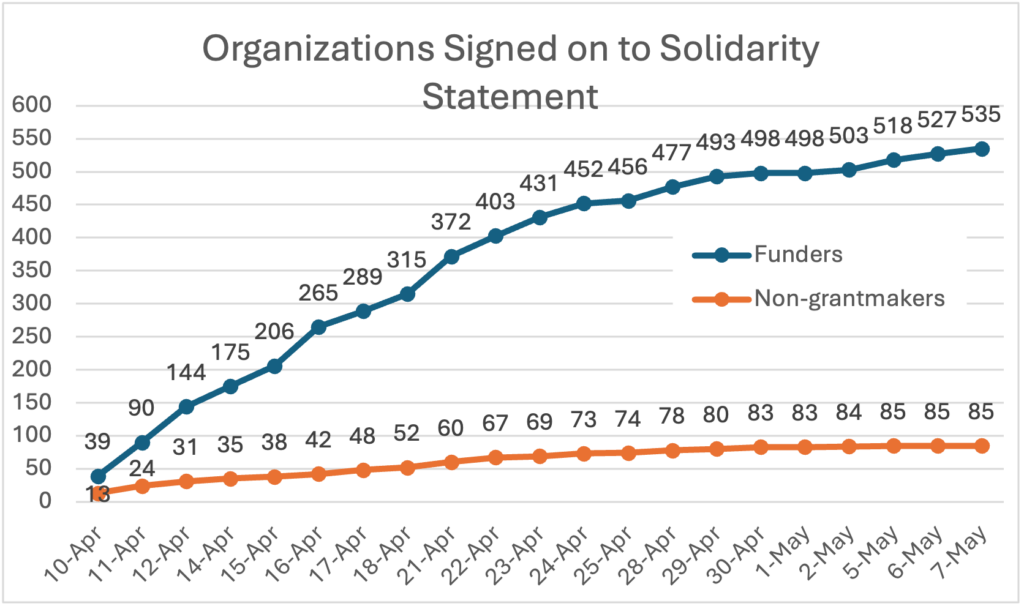
Philanthropy has its own solidarity statement, announced on April 9 by Palfrey, Tonya Allen of McKnight Foundation, and Deepak Bhargava of Freedom Together Foundation. The statement is hosted by the Council on Foundations, and I applaud all 535 funders (and 85 non-grantmaking organizations) that have signed on.
However, if one measure of power is the amount that funders give, we’re still missing a lot of important names. By my count, just under half of the 20 largest private and community funders (measured by giving) and only about a quarter of the largest 200 givers have signed on, even though the philanthropy statement is worded more cautiously than the higher ed statement. Just last week a staff member at a big foundation told me, “we’re still being told not to write anything down in email to our grantees.”
I worry that both public and private silence accepts a false premise that our social sector efforts are somehow illicit instead of something above board — and wonderful. So, I hope more sign on quickly. Do you think it matters at this point, though?
Phil: Yes, I think it matters, absolutely. I think we know from examples around the globe that aligned, coordinated resistance to threats to civic space from a broad coalition is essential in facing down authoritarianism (I’ll once again recommend this article by Rachel Kleinfeld). The statement COF is hosting is not remotely controversial: it just says folks should be free to give where they want to give. It’s like the bare minimum, in my view, and I share your wish that more would sign on. I know and totally understand that there are some funders that, as a matter of practice, try to keep a low profile and won’t sign onto anything. I get that. But for those that historically have been out there publicly on issues, I think it’s important to sign on.
I’d also like to see more funders sign on to the pledge put forth by the Trust-Based Philanthropy Project in partnership with National Center for Family Philanthropy and Grantmakers for Effective Organizations, too — because it includes specific steps that I think are crucial to support nonprofits right now.
Look, I get that every funder’s context is different, so if these aren’t exactly the right steps for you then at least consider which ones are. That discussion should be rooted in an understanding of what nonprofits are facing right now. We know from our research and from Grantee Perception Reports (GPRs) that many are reeling, including from cuts to federal funding. I am pleased by the actions we are seeing some funders take, which you and our colleague Molly Heidemann and I tried to chronicle a few weeks back. Yet I also share your concern about the level of cautiousness that prevails among others. I feel both ways at the same time.
Kevin: I certainly don’t understand all the dynamics inside funders and their boards, so in addition to hoping we hear from more funders, I’m trying to take action here at CEP where I can — adding a couple of questions to our surveys that rapidly put the needs of nonprofits in front of funders, grabbing some space on our blog to speak out and to celebrate funders’ responses, and trying to name what’s true when others try to distort the collective work of nonprofits and funders.
Phil: Yes. We have worked together for more than a quarter century, which is insane and also amazing, going back to our days together at a management consulting firm, and I am not sure I have ever seen you so focused and determined. I think we’d both say that of our colleagues, too. I know that, right now, we’re in a sometimes uncomfortable position because some of our longest standing clients and funders don’t necessarily agree with what we’re advocating in terms of how to approach this moment. But hopefully we can have this healthy debate about the right tactics in this time even as we work together.
It’s shocking to see the politicized attacks on the sector, even though we knew they were coming, because most of the work I see nonprofits doing couldn’t even be placed on an ideological spectrum — and supports and betters the lives of people of all ideological stripes and political affiliations. I’m thinking of Meals on Wheels and Boys and Girls Clubs and cultural institutions enjoyed by everyone. I’m thinking of organizations that maintain trails for people to walk, or that run hot lines for people to call in a crisis. I could go on, but I won’t. I’ll just say I keep thinking of how George H.W. Bush talked so movingly as a presidential candidate in 1988 about community organizations as “a brilliant diversity spread like stars, like a thousand points of light in a broad and peaceful sky.” Yet here we are with the sector being attacked by a president.
Kevin: Phil, you more than most know that I’m pretty comfortable with disagreement and debate as we seek the best approaches to difficult questions about what to do. It’s cynicism about the work of the social sector that pisses me off. Sure, I worry that silence can be too easily read as passivity or cowardice. But the reality of my current experience at CEP and with the vast majority of the funders we work with is that we’re all trying, earnestly and with good intention, to find the best way to continue our sector’s selfless work in a uniquely challenging moment.
Find more resources for funders on responding to the current context here.
Kevin Bolduc is vice president, Assessment and Advisory Services, at CEP. Phil Buchanan is president of the Center for Effective Philanthropy, author of the 2019 book Giving Done Right: Effective Philanthropy and Making Every Dollar Count, and co-host of the Giving Done Right podcast.
- MacArthur Foundation has provided grant support to CEP and has been a regular client, using our Grantee Perception Report to get feedback and input from its grantees. ↩︎