



When a foundation shifts course or steps away, what happens to the work — and to the people who depend on it?
Few funders will support a single strategy or approach indefinitely. Needs routinely exceed available resources, forcing difficult choices about where a foundation can invest to achieve the most good.
Funders exit fields, initiatives, or geographies for different reasons. Strategies change, markets and budgets shift, political windows open or close, leaders transition, and some even commence the intentional spenddown of resources. Although funders aspire to exit once our goals have been met, the reality is social change is dynamic, complex, and long-term. Social issues are rarely “solved.” More often, we move on hoping to leave positive momentum for grant partners, the communities they serve, and the field.
But exits do not affect funders and grant partners equally. For grant partners, exits can mean funding cuts, reduced services for critical programs, and in some cases, the end of a program, initiative, or organization altogether. For certain fields, losing a key funding source, convenor, or strategic thought partner can be disruptive and shift the burden of work to already stretched partners. Power and reduced proximity can shield funders from some of these negative consequences.
How we exit matters. A poorly executed transition risks undermining the progress made by a funder’s involvement, or worse — harming field partners and the work. In contrast, a responsible exit can help the work continue long after the foundation ceases its funding.
But what is a responsible exit? Together, we dug into the literature, conducted focus groups and interviews with foundation staff and grant/field partners, and drew upon our own experiences to answer this question. We learned a responsible exit centers equity, prioritizes transparency, focuses on sustainability, and engages respectfully with grant partners. Here are seven principles to help philanthropy exit more responsibly.1
Seven Core Principles: A Hiker’s Metaphor
To bring our framework to life, we use a hiking metaphor. Imagine social impact as a journey, with funders as one group of hikers joining others — nonprofit partners, community stakeholders — along the trail. While we may walk part of the path, the journey began before we arrived and will continue long after we depart. Like responsible hikers, responsible funders must begin and end our journey with care, leaving the trail — and the field — unharmed and, ideally, stronger than we found it.
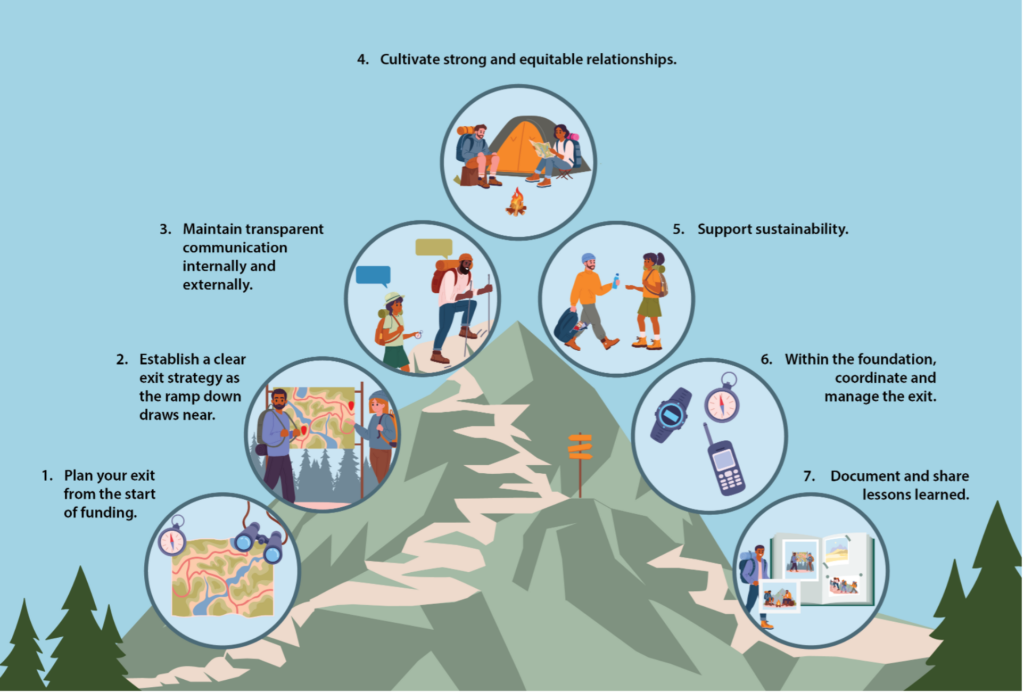
Illustration: Paula Ginsborg/iStock
1. Begin with the End in Mind: A Responsible Entrance
A responsible exit begins with a responsible entrance. Just as a hiker must know their destination before starting their trek, a foundation’s entrance into a new area of work should begin with a clear understanding of goals and intentions for the journey ahead. We should be transparent from the outset with grant partners about why we are entering a space and under what circumstances we will consider or plan to leave.
2. Map the Exit Journey: Establish a Clear Exit Strategy
Just as a hiker needs a clear path, funders should develop a thoughtful exit plan that includes a timeline and remains flexible. Careful preparation helps minimize disruptions to the field and grant partners after our departure. We should anticipate disparate impacts for grant partners based on various circumstances — budget size, financial situation, support or lack thereof from other funders — and proactively develop appropriate mitigation strategies in service of equity in our exit plans.
3. Stay on Track: Communicate Clearly and Frequently
A hiker checks their map and compass regularly to stay on track. Similarly, funders must maintain clear, transparent, and frequent communication with all stakeholders about the exit. Bi-directional communication fosters trust, and keeping stakeholders informed allows them to ask questions, provide input, and prepare for the transition.
4. Build Strong Connections Along the Way: Cultivate Equitable Relationships
A hike becomes more enjoyable and meaningful through connections made with fellow hikers. A foundation’s exit, too, should be built on strong, equitable relationships with grant partners and other stakeholders. The extent to which relationships are nurtured early on can determine how smooth or difficult the exit process will be. Responsible exits center equity, attend to relationships, and manage power dynamics, recognizing that connections have enduring value that extends beyond individual grants or initiatives.
5. Mind the Terrain: Plan for Sustainability and Long-Term Support
Just as hikers often share provisions to support each other on the journey, foundations should support field partners in sustaining themselves in the long term. This longer-term lens should not be an afterthought when we already have one foot out the door; it should be there at the start. Intentional investments in capacity strengthening through the duration of a funder’s involvement in a space can increase organizational resilience and contribute to charting a sustainable path post-exit. Wherever possible, we should avoid abrupt exits, using reasonable exit ramps and step downs of at least one year — and as one interviewee advised, focusing on equitable, not equal, off-ramps.
6. Check Your Supplies: Ensure Internal Infrastructure for Exit Management
A successful hike requires the right gear and support. Similarly, we funders must ensure we have the right infrastructure in place to manage the exit effectively. A strong exit is likely to need involvement and alignment from program, communications, evaluation, and finance staff. We should evaluate short-, mid-, and long-term impacts — and be explicit about equity considerations in those analyses, asking: which grant partners are most vulnerable and will be hardest hit by the exit?
7. Reflect and Share Your Journey: Learn and Share Insights
Just as hikers reflect on their journey to gather insights for future expeditions, we should take time to document our investments and field progress and share lessons learned. This reflection not only improves future exits but also enhances the field’s practices and returns valuable knowledge to the broader philanthropic community.
Unresolved Tensions
We fully acknowledge the limitations of this framework and the tensions that remain. Exit decisions are often opaque or beyond the control of the foundation staff who are tasked with communicating them to grant partners. Exits can be deeply emotional, especially for staff who have built strong personal relationships with grant partners over time. And timing communication is tricky: too early can cause unnecessary stress for the field, while waiting too long makes it harder for partners to plan or recover from the disruption.
Additionally, power imbalances persist throughout the exit process. While we funders can acknowledge power imbalances, the decision of when and how we exit ultimately rests with us. Despite our best efforts, none of us can ensure the full sustainability of field partners once we leave, as fields are dynamic and rely on a range of actors who must themselves adapt and evolve.
An Invitation to the Field
How we funders choose to exit investments is as important as how we enter. Without intentionality, equity, and transparency, an exit can destabilize ecosystems, harm communities, and undermine the very goals we aim to achieve. We do not offer this framework as a rigid formula, but instead as a set of guiding principles to navigate the inevitable complexities of philanthropic exits. We hope this can spur renewed conversations in our field about the responsibility funders have to the ecosystems and partners with whom we engage, especially at this exceedingly vulnerable time.
As philanthropy seeks to address generational challenges like systemic inequities, racial justice, climate change, and inadequate health care and education, we must embrace our roles as partners in progress. Responsible exits are a critical step in realizing this shift. We invite you, our philanthropic colleagues, to critique and build upon the ideas shared here, because strengthening our collective practice is work we must do together.
Laila Bell, M.P.A., is vice president of learning and impact at The Skillman Foundation. Stephanie Teleki, Ph.D., is director of learning and impact at The California Health Care Foundation. Jaime Vazquez, M.A., started this work as a former associate of strategy, learning, and impact at Omidyar Network and is now senior associate of planning and evaluation at The Pew Charitable Trusts.
- This blog is based the following published article: Bell, L., Teleki, S., & Vazquez, J. (2025). When Shift Happens: Navigating Toward a Framework for Responsible Philanthropic Exits. The Foundation Review, 17(3). ↩︎